
Introduction
In modern manufacturing, maintaining consistent product quality, improving production efficiency, and minimizing inspection errors are essential for achieving reliable industrial operations. Traditional quality inspection methods often depend on manual observation, periodic sampling, or conventional sensor-based systems, which may struggle to detect complex visual defects at high production speeds. Industrial Vision AI addresses these challenges by combining camera technologies, digital image processing, artificial intelligence, and industrial automation to enable intelligent visual inspection. By capturing and analyzing images directly from production environments, vision systems can identify defects, verify product characteristics, monitor manufacturing processes, and provide valuable operational insights. As industries move toward smarter and more connected production systems, AI-assisted machine vision is becoming an important technology for improving inspection accuracy, supporting automated quality control, and enabling data-driven manufacturing decisions.
Understanding Industrial Vision AI
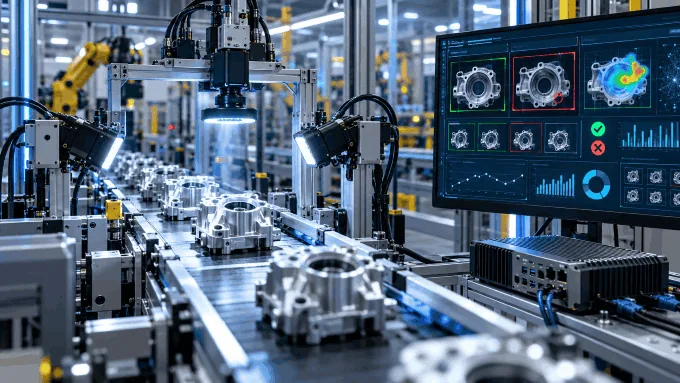
Industrial Vision AI refers to the application of computer vision algorithms and artificial intelligence techniques to analyze visual information captured from industrial machines, products, and manufacturing environments. Unlike conventional vision systems that primarily depend on predefined rules, thresholds, and geometric measurements, AI-assisted vision solutions can learn complex visual patterns from image datasets and recognize variations that may be difficult to describe through traditional programming. Industrial Vision AI systems typically consist of cameras, illumination equipment, image acquisition interfaces, processing hardware, and inspection software. These components work together to capture images, extract useful features, identify defects, and generate inspection results. Depending on the application, vision systems may perform dimensional verification, object detection, component counting, surface defect identification, assembly verification, or product classification. By integrating visual intelligence into manufacturing operations, organizations can improve inspection consistency while reducing dependence on repetitive manual inspection activities.
Camera Streaming and Industrial Image Acquisition
Camera streaming is a fundamental component of Industrial Vision AI because inspection performance depends heavily on the quality, timing, and reliability of captured images. Industrial vision systems may use IP cameras, USB cameras, GigE Vision cameras, or other industrial imaging devices, depending on production requirements. Network-based cameras can transmit video streams through Ethernet connections, while dedicated industrial cameras may provide hardware triggering, exposure control, and precise image acquisition capabilities. Technologies such as RTSP are commonly used for transporting video streams from compatible IP cameras, enabling software applications to receive and process visual information. In continuous monitoring applications, frames can be captured at defined intervals or processed at selected frame rates based on inspection needs. Engineers must consider camera resolution, frame rate, exposure time, network bandwidth, image compression, and processing latency when designing a vision system. Selecting an appropriate acquisition architecture ensures that inspection software receives images of sufficient quality while maintaining reliable performance in industrial environments.
Image Processing and Computer Vision Techniques
Image processing forms the foundation of many industrial vision applications by transforming raw camera images into structured information that software can analyze. Common processing operations include image resizing, grayscale conversion, noise reduction, contrast enhancement, thresholding, edge detection, contour extraction, and geometric measurement. These techniques help isolate important regions, improve feature visibility, and reduce the influence of background variations. For example, a vision system inspecting manufactured components may use edge detection to identify object boundaries, contour analysis to measure shapes, and pixel-based techniques to detect missing features or surface irregularities. OpenCV and similar computer vision libraries provide practical tools for implementing these operations across different computing platforms. Traditional image processing is particularly effective when inspection requirements are well defined and imaging conditions are controlled. Combining these techniques with AI models allows developers to build more flexible systems that can handle complex product variations and challenging inspection conditions.
AI-Assisted Defect Detection and Quality Inspection
Artificial intelligence expands the capabilities of industrial vision systems by enabling the detection and classification of visual patterns that may be difficult to identify using conventional algorithms alone. Machine learning and deep learning models can be trained to recognize acceptable products, identify abnormal features, and distinguish between different defect categories. In manufacturing environments, AI-assisted inspection can support the detection of scratches, cracks, dents, incorrect assembly, missing components, packaging defects, and other visible quality issues. Convolutional neural networks, object detection models, segmentation networks, and anomaly detection algorithms are among the approaches used for industrial inspection. The selection of an appropriate model depends on factors such as defect characteristics, image resolution, available training data, processing requirements, and expected inspection accuracy. Although AI can improve flexibility and recognition capabilities, effective deployment requires representative training datasets, systematic validation, and continuous evaluation to ensure reliable performance across real production conditions.
Real-Time Vision Processing and Performance Optimization
Real-time processing is an important consideration when deploying Industrial Vision AI in manufacturing facilities where products move continuously through production lines. A vision system must capture images, process visual information, generate inspection results, and communicate decisions within the time available for each production operation. Processing requirements vary depending on camera resolution, image complexity, inspection algorithms, and the capabilities of the computing hardware. Lightweight image processing tasks may be performed efficiently on standard industrial PCs, while complex deep learning models may benefit from graphics processing units or dedicated AI accelerators. Engineers can improve processing performance by selecting appropriate image resolutions, processing only relevant regions, reducing unnecessary memory transfers, and optimizing model inference. Multithreaded or asynchronous system architectures can separate image capture from analysis and communication tasks, reducing the risk of processing delays affecting camera acquisition. Careful performance testing is essential to ensure that an inspection system meets application-specific throughput and latency requirements without sacrificing the accuracy of inspection results.
Edge AI and Local Vision Intelligence
Edge AI enables image processing and machine learning inference to take place directly on computing devices located near industrial cameras and production equipment. Instead of transmitting every captured image to a remote cloud platform, edge-based vision systems can analyze image streams locally and send inspection results, alerts, or selected image records to other applications. This architecture can reduce network bandwidth requirements, minimize communication delays, and improve operational continuity when external connectivity is limited. Industrial PCs, embedded processors, and AI-enabled edge devices can serve as processing platforms depending on system complexity. For applications requiring continuous inspection, local processing also allows developers to manage image acquisition, detection, and response workflows without relying on remote services for every decision. Edge AI is particularly useful in manufacturing environments where rapid inspection results, controlled data storage, and integration with existing automation equipment are important operational requirements.
Integration with PLCs and Industrial Automation Systems
Industrial vision systems become more valuable when they are integrated with existing automation equipment and production control infrastructure. Programmable Logic Controllers (PLCs) can exchange information with vision processing applications to coordinate inspection triggers, receive inspection results, and initiate appropriate machine actions. For example, a camera-based inspection system may analyze a product moving along a conveyor and communicate a pass or fail result to a PLC, which can activate a rejection mechanism when a defective component is identified. Communication technologies such as OPC UA, Modbus TCP, digital I/O, and manufacturer-specific industrial protocols can support integration depending on the equipment and system requirements. Standardized approaches such as OPC UA for Machine Vision also provide information models for exchanging inspection results, configurations, and operating states between vision systems and industrial applications. Reliable integration requires careful management of timing, result identification, communication failures, and synchronization between image acquisition and machine operations.
Multi-Camera Monitoring and Centralized Vision Systems
Many manufacturing applications require multiple cameras to monitor different production stages, inspection points, or machine operating conditions. A multi-camera vision architecture enables manufacturers to collect visual information from several locations and process it through centralized or distributed computing resources. Each camera may perform a dedicated task, such as checking product alignment, verifying component presence, monitoring material levels, or detecting surface defects. A centralized industrial PC can manage multiple camera streams, process selected frames, and maintain the latest inspection results for connected applications. Alternatively, processing workloads can be distributed across edge devices to improve scalability and reduce computational bottlenecks. Developers must consider aggregate network bandwidth, camera frame rates, processor utilization, memory requirements, and image processing latency when designing these systems. Effective resource management ensures that each camera receives sufficient processing capacity while maintaining reliable inspection performance across the entire production environment.
Industrial Vision for Measurement and Process Monitoring
Beyond defect detection, Industrial Vision AI can be applied to measurement and continuous process monitoring tasks. Camera-based systems can estimate object dimensions, measure distances, identify component positions, count manufactured items, and monitor the movement or level of materials within industrial equipment. For example, vision processing can be used to observe fluid levels in transparent containers, track the position of mechanical components, or verify whether products are correctly placed during assembly. These applications typically require careful calibration to convert image coordinates into meaningful physical measurements. Calibration may involve known reference dimensions, camera geometry correction, lens distortion compensation, and controlled image acquisition conditions. The achievable measurement accuracy depends on camera resolution, optics, lighting stability, object positioning, and the selected processing algorithm. Where high-precision measurements are required, the system must be validated against suitable reference instruments to ensure that visual estimates meet the application's accuracy requirements.
Lighting, Camera Positioning, and Image Quality
Reliable image acquisition is one of the most important factors influencing the success of an industrial vision system. Even advanced AI models may produce inconsistent results when images are affected by poor illumination, reflections, motion blur, shadows, or changes in camera positioning. Industrial environments often contain reflective surfaces, moving machinery, variable lighting, and vibration, all of which can affect inspection reliability. Engineers must therefore select suitable lighting arrangements, camera lenses, mounting structures, exposure settings, and image capture methods. Depending on the application, backlighting, diffuse illumination, directional lighting, or specialized optical techniques may improve the visibility of important product features. Hardware-triggered image capture can also help ensure that images are acquired when products are correctly positioned within the inspection area. By establishing controlled imaging conditions, manufacturers can improve measurement repeatability, reduce false detections, and achieve more consistent inspection performance.
Data Logging, Inspection Records, and Traceability
Inspection data management plays an important role in manufacturing quality assurance and process improvement. Industrial vision systems can record inspection results, defect classifications, timestamps, camera identifiers, and selected images to support production traceability. These records help quality engineers investigate rejected products, identify recurring defect patterns, and evaluate changes in manufacturing conditions. Image storage policies can be configured according to operational requirements, allowing systems to retain recent inspection images, preserve evidence of detected defects, or archive selected records for future analysis. Integration with manufacturing databases, production management software, or Manufacturing Execution Systems (MES) can further associate inspection results with production batches, machine identifiers, and product information. Structured data logging also provides valuable information for evaluating AI model performance and identifying opportunities to improve inspection algorithms. Effective retention policies and storage management are essential to ensure that vision systems remain efficient during continuous industrial operation.
Real-Time Alerts and Automated Inspection Decisions
Industrial Vision AI enables manufacturers to move beyond passive visual monitoring toward automated inspection workflows. When a defect, missing component, incorrect alignment, or abnormal process condition is detected, the vision application can generate an inspection result and communicate the relevant information to connected systems. Depending on operational requirements, the system may display a warning on a monitoring dashboard, record an inspection event, notify maintenance personnel, or send a control signal to a PLC. For high-speed production environments, inspection decisions must be communicated within the permitted machine cycle time. This requires careful coordination between camera acquisition, image processing, AI inference, and industrial communication. Engineers must also design appropriate handling for uncertain classifications, missing frames, communication interruptions, and processing failures. By combining intelligent analysis with clearly defined automation logic, industrial vision systems can support more consistent inspection decisions and improve response times during manufacturing operations.
AI Model Development and Continuous Improvement
Developing an effective Industrial Vision AI solution requires more than selecting a machine learning model. The development process begins with understanding the inspection requirements, identifying relevant product characteristics, and collecting representative image datasets. Training images should reflect expected production variations, including differences in product appearance, lighting conditions, machine positions, and acceptable manufacturing tolerances. Defective samples must be accurately categorized where supervised learning approaches are used. After model training, engineers should evaluate inspection performance using independent validation data and practical production trials. Important evaluation criteria may include detection accuracy, false rejection rates, missed defect rates, processing latency, and performance under changing operating conditions. As production processes evolve, AI models may require periodic evaluation and retraining to maintain reliable results. A structured model development and validation process helps manufacturers deploy inspection systems that remain effective and adaptable over time.
Challenges in Industrial Vision Implementation
Implementing Industrial Vision AI in real manufacturing environments introduces several engineering and operational challenges. One common challenge is maintaining consistent image quality when products vary in appearance, orientation, surface finish, or position. Environmental conditions such as vibration, dust, temperature changes, and unstable illumination may also influence camera performance. From a software perspective, developers must manage continuous video streams, image buffering, processing workloads, communication interfaces, and data storage without creating unnecessary delays. AI-assisted inspection introduces additional considerations related to training data quality, model generalization, and the cost of incorrect classifications. Industrial integration may require compatibility with existing controllers, secure network configuration, and carefully defined error-recovery procedures. Addressing these challenges requires collaboration between automation engineers, software developers, machine vision specialists, and production teams. Thorough testing under actual operating conditions is essential before deploying vision-based inspection as part of critical manufacturing workflows.
MayilVeera's Approach to Industrial Vision AI
MayilVeera's industrial vision approach emphasizes the integration of camera technologies, embedded computing, industrial communication, and intelligent software processing to support practical manufacturing applications. By combining image acquisition with computer vision algorithms and AI-assisted analysis, industrial solutions can be designed to monitor machine conditions, inspect product characteristics, and transform visual information into actionable operational data. This approach can support applications such as automated visual inspection, component detection, process monitoring, dimensional analysis, and camera-based measurement. Integration with industrial PCs, edge computing platforms, PLCs, and monitoring software enables vision processing to operate as part of a broader automation environment rather than as an isolated application. The engineering focus is on developing efficient, reliable, and adaptable vision workflows that align with actual production requirements while supporting future expansion into advanced analytics and intelligent manufacturing systems.
Industrial Vision AI and Industry 4.0
Industrial Vision AI plays an important role in Industry 4.0 by connecting visual inspection capabilities with digital manufacturing infrastructure. As factories increasingly adopt Industrial IoT, edge computing, and automated production management systems, camera-generated information can become an additional source of operational intelligence. Inspection results can be combined with machine parameters, production counts, process measurements, and quality records to provide a more comprehensive understanding of manufacturing performance. Vision systems can also support robotic guidance, automated assembly verification, packaging inspection, and production traceability. When integrated with suitable industrial communication standards and software platforms, visual inspection information can be shared with supervisory applications, quality management systems, and enterprise-level analytics tools. This connectivity supports faster identification of manufacturing issues, improved production transparency, and more informed operational decisions.
Future of AI-Powered Industrial Vision
The continued development of artificial intelligence, imaging technologies, and embedded computing is expanding the possibilities for industrial vision applications. Improvements in AI model efficiency, hardware acceleration, camera resolution, and edge processing capabilities are making it increasingly practical to perform sophisticated image analysis directly within manufacturing environments. Emerging approaches involving advanced anomaly detection, three-dimensional imaging, intelligent robotic vision, and adaptive inspection algorithms may further extend the capabilities of machine vision systems. At the same time, standardized communication frameworks and modular software architectures are helping simplify integration between camera systems and industrial automation equipment. Future industrial vision solutions are likely to place greater emphasis on explainable inspection decisions, efficient model deployment, continuous performance monitoring, and seamless interaction with connected manufacturing platforms. These advancements can help industries develop increasingly flexible and intelligent quality control systems.
Conclusion
Industrial Vision AI provides a powerful foundation for transforming camera-generated visual information into intelligent inspection results and meaningful manufacturing insights. By combining reliable image acquisition, computer vision processing, artificial intelligence, edge computing, and industrial communication, manufacturers can develop automated inspection systems capable of supporting product quality, process monitoring, and operational efficiency. From continuous camera streaming and defect identification to multi-camera monitoring, measurement applications, and PLC integration, industrial vision technologies offer a wide range of practical manufacturing capabilities. MayilVeera's industrial vision approach highlights the importance of connecting visual intelligence with existing automation infrastructure to create scalable and efficient industrial applications. As manufacturing environments continue to evolve toward connected, data-driven, and increasingly automated operations, Industrial Vision AI will remain an important technology for improving inspection consistency, reducing manual effort, and supporting future-ready production systems.