
Continuous Testing Across Build, Deployment, and Release

Move quality checks closer to every software change with automated build verification, application tests, API tests, protocol tests, deployment validation, and release-quality evidence.

BuildChecks
ReleaseGates
MonitorFeedback
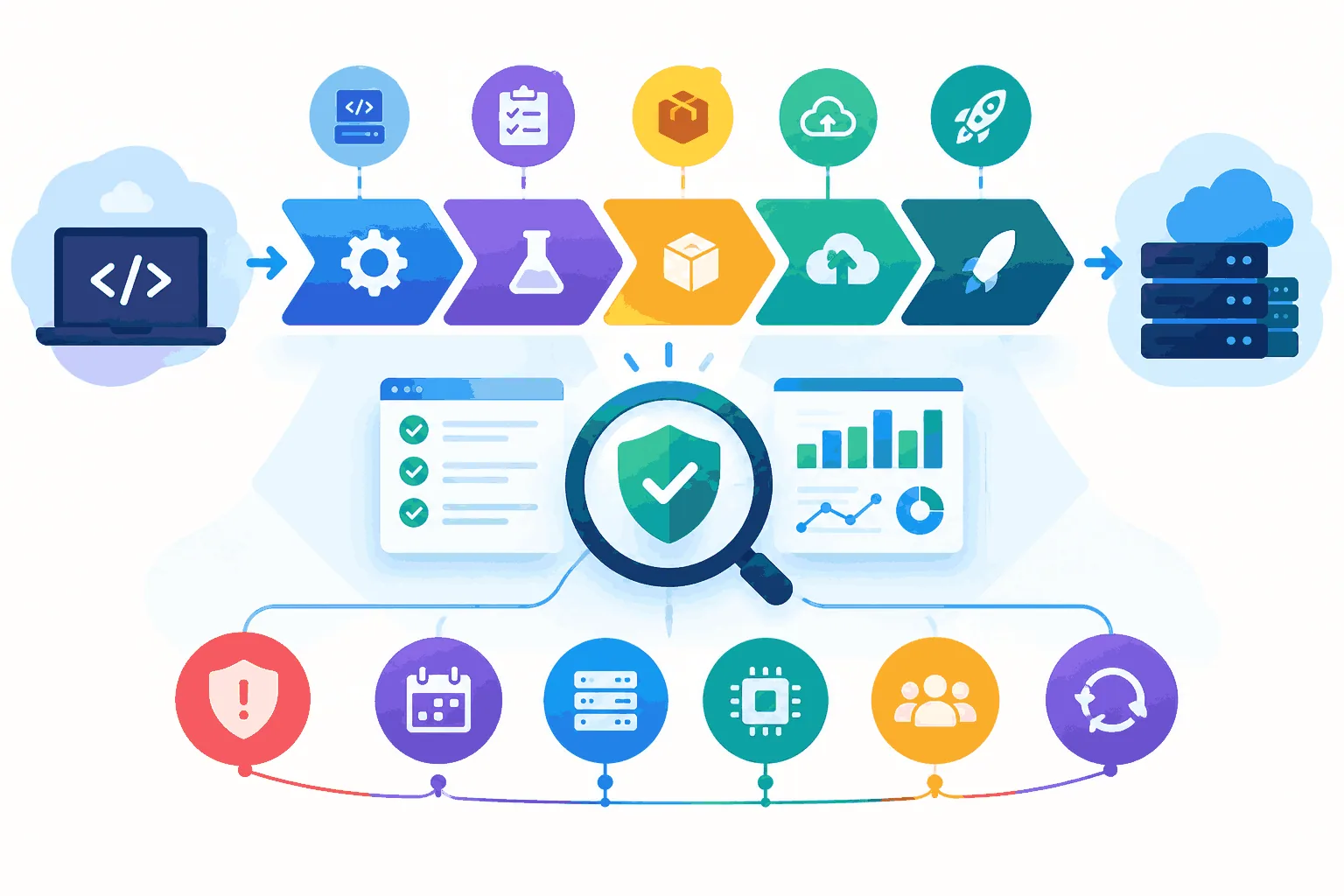
Continuous testing and DevOps quality pipeline

Make Release Quality Visible

A fast delivery pipeline is useful only when it produces repeatable, testable, and recoverable releases.

MayilVeera helps teams introduce quality checks at appropriate stages of the software-delivery process. The objective is not to automate deployment at any cost; it is to detect problems earlier, make release evidence visible, and reduce variation between environments.

The final pipeline is designed around product risk, release frequency, target environment, hardware dependencies, customer approval process, and rollback capability.

Our Continuous Testing and DevOps Services

Build verification, automated testing, deployment validation, quality gates, release evidence, and monitoring integrated into CI/CD workflows.

Source and Change Validation

Verify repository state, branch policy, required review, commit information, configuration changes, dependency changes, build definitions, test changes, and release notes where required.
Build Verification

Automate clean builds, compiler warnings, static analysis, unit tests, package creation, dependency resolution, reproducibility, firmware-image creation, container-image creation, version generation, artifact naming, and artifact integrity.

Automated Test Stages

Run unit, component, API, integration, UI, protocol, database, configuration, security-related, smoke, regression, performance, and deployment validation checks at appropriate stages.

Environment Provisioning

Prepare repeatable development, integration, test, staging, simulator, test database, containerised service, application configuration, test account, and representative dataset environments.

Deployment Validation and Quality Gates

Verify health, version, APIs, migrations, dependencies, authentication, configuration, basic workflows, logging, monitoring, message flow, rollback readiness, and release gate rules.

Monitoring and Feedback

Route production or field observations such as application errors, device logs, failed jobs, performance degradation, restarts, communication failures, user defects, data-quality failures, deployment failures, and rollback events back into quality engineering.

Continuous Testing for Embedded and Industrial Products

Industrial products often combine fast software checks, scheduled integration checks, target-hardware checks, and release approval evidence.

Fast software checks

Integration checks

Target hardware checks

Deployment validation

Quality gates

Release packaging

Release traceability

Rollback readiness

Pipeline Stages

Not every project needs every stage. The process should match the product's risk and delivery model.

Source Change and Review

Source change, review, branch policy, and required approval checks.

Build and Static Checks

Build, static checks, unit tests, package creation, artifact naming, and artifact integrity.

Integration Tests

Integration tests, simulator tests, database tests, protocol regression, and application workflows.

Deploy to Test

Deploy to test, smoke test, regression test, deployment validation, and rollback preparation.

Approval

Test summary, known defects, hardware and software versions, unverified areas, deployment plan, rollback plan, and authorised approval.

Production and Monitoring

Production deployment, post-deployment verification, monitoring, alerts, feedback, and new regression coverage for confirmed defects.

DevOps Quality Deliverables

Depending on scope, deliverables can define the current pipeline, target workflow, build controls, quality gates, deployment flow, rollback, and operations handover.

01Current-pipeline assessment
02Target workflow
03Repository and branching recommendation
04Build configuration
05Automated test integration
06Environment definition
07Quality-gate rules
08Artifact-management process
09Deployment workflow
10Rollback procedure
11Release checklist
12Pipeline dashboard
13Failure-notification setup
14Access-control design
15Operational runbook
16Knowledge-transfer documentation

Frequently Asked Questions

Q

Is DevOps Testing a separate type of testing?

A

It is better understood as integrating testing and quality controls throughout the delivery pipeline rather than waiting until the final release stage.

Q

Can CI/CD be used for embedded firmware?

A

Yes. Compilation, analysis, unit tests, packaging, and simulated tests can be automated. Target flashing and hardware tests require a suitable connected environment and hardware-access controls.

Q

Should every successful pipeline automatically deploy to production?

A

No. High-risk, industrial, customer-hosted, hardware-dependent, or regulated products may require manual approval before deployment.

Q

Can the pipeline test real devices?

A

Yes, if a controlled device lab, runners, programming interfaces, power control, network access, safe loads, test fixtures, and recovery procedures are available.

Q

What happens if an automated test fails intermittently?

A

The result should be investigated. Intermittent tests should not simply be ignored or repeatedly rerun until they pass.

Q

Does CI/CD improve product quality automatically?

A

No. CI/CD makes checks repeatable and visible. Quality still depends on clear requirements, good test design, meaningful coverage, controlled environments, and engineering response to failures.

Build Quality Checks Into Every Release

Share your repository, build process, current tests, deployment environments, device dependencies, release frequency, and approval requirements.

Request a DevOps Quality Assessment
Find us

MayilVeera Tech Solutions and Consultancy

Visit or contact our Chennai team for industrial automation, embedded systems, product engineering, IIoT, and connected-device discussions.

Open in Maps