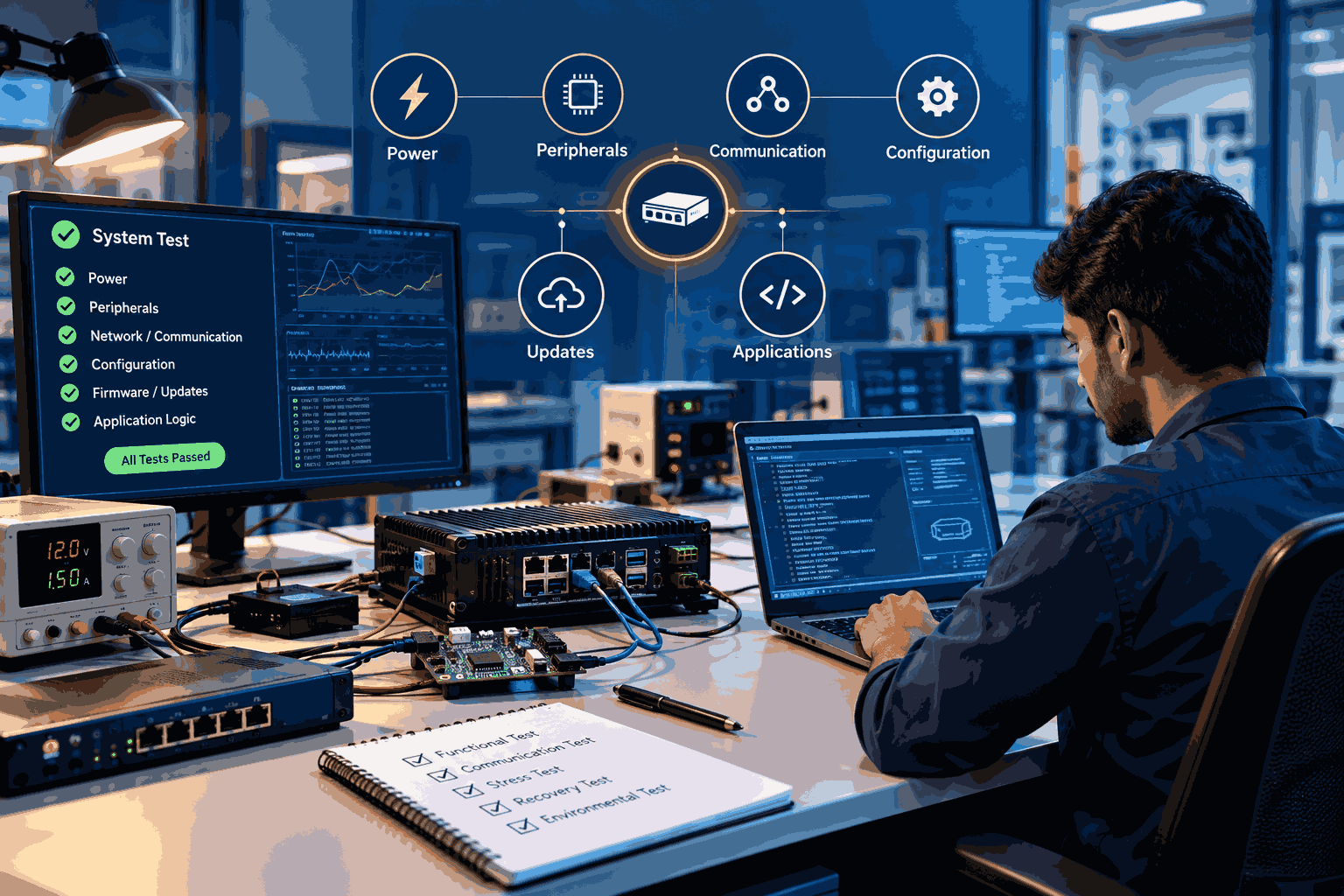
Structured testing for electronics, firmware, interfaces, configuration, communication, diagnostics, recovery, and long-duration behaviour.
Requirement and Architecture Review
Review device functions, hardware architecture, firmware modules, interfaces, protocols, configuration, power behaviour, startup and shutdown, update mechanism, diagnostics, safety boundaries, and operating environment.
Board and Power Verification
Check power rails, startup sequence, reset behaviour, current consumption, brownout recovery, watchdog behaviour, clock and programming interfaces, signal integrity observations, thermal observations, and approved protection behaviour.
Firmware Functional Testing
Verify state-machine behaviour, configuration, non-volatile storage, sensor handling, output control, timing, interrupts, communication, error handling, diagnostics, logging, restart, recovery, and firmware-version reporting.
Interface and Configuration Testing
Test GPIO, ADC, DAC, PWM, UART, RS-232, RS-485, SPI, I2C, CAN, Ethernet, USB, Wi-Fi, Bluetooth, storage, displays, sensor inputs, outputs, valid settings, invalid inputs, factory reset, permissions, and update migration.
Communication and Update Testing
Check connection establishment, addressing, message correctness, timeouts, retries, reconnection, duplicate handling, network interruption, peer restart, firmware updates, interrupted updates, recovery mode, rollback, and remote status reporting.
Recovery, Endurance and Interoperability
Test cold startup, warm restart, power cycling, absent peripherals, invalid configuration, watchdog reset, long-run memory growth, resource exhaustion, communication loss, data loss, timing drift, and interoperability with defined PLCs, clients, servers, gateways, applications, and tools.