
OPC UA server and/or client role, according to package
Add Structured and Secure OPC UA Connectivity to Industrial Products
Integrate OPC UA client or server functions into gateways, controllers, machines, industrial applications, and embedded products using a reusable software stack.
StructuredInformation Models
SecureOPC UA Connectivity
EmbeddedProduct Integration
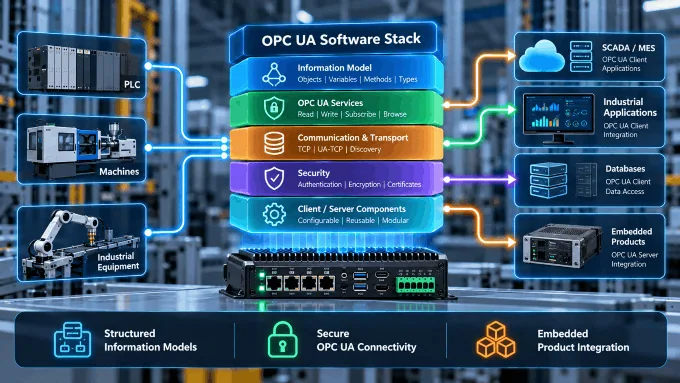
OPC UA Software Stack
The MayilVeera OPC UA Software Stack is intended to provide reusable OPC UA communication functions for supported embedded and software platforms. Depending on the licensed package, it may include server, client, information-model, session, security, subscription, and transport components.
OPC UA includes information modelling, services, transport, security, and platform-independent interoperability concepts. The exact supported profiles, services, security policies, and conformance status must be published for the MayilVeera implementation. See the OPC Foundation’s OPC UA overview.
Logical Architecture
A website-level view of how the product connects sources, processing layers, diagnostics, and destination systems.
Industrial Application / Product Data
01
Application Integration API
02
Information Model and Node Layer
03
OPC UA Services and Subscription Layer
SessionsChannelsUsersSecurity
04
OPC UA Transport Layer
05
Operating-System and Network Abstraction
Ethernet / TCP/IP / Supported Transport
Key Capabilities
Address-space and information-model integration
Browse, read, write, and subscription services as supported
Session and connection management
Certificate-based communication
User authentication and authorisation, where implemented
Event, method, historical-access, or PubSub modules only when included
Platform-abstraction interfaces
Diagnostic logging
Integration examples and developer APIs
How It Works
The document flow is presented as an implementation-style process so visitors can understand the operating path quickly.
- 01
The application registers or maps product data into the OPC UA information model. The stack manages supported OPC UA services, sessions, secure channels, subscriptions, encoding, and transport. Application callbacks connect OPC UA reads or writes with the product’s internal data.
Applications
Where It Fits
Embedded OPC UA servers
Industrial gateways
Machine-controller connectivity
OPC UA-enabled instruments
SCADA and HMI applications
Protocol-conversion products
Edge gateways
Test tools and simulators
OEM industrial devices
Existing product modernisation
Benefits
Practical Benefits
Reduces the need to build OPC UA protocol handling from the beginning
Separates application data from communication details
Supports structured industrial information exchange
Provides a reusable basis across compatible product lines
Can shorten integration work when platform and profile requirements match
Integration and Deployment
Integration must define the required role, OPC UA profile, namespace and information model, node count, data access, subscriptions, security policies, users, certificates, platform abstraction, resource limits, and conformance expectations.
Reliability and Security
Secure-channel and session management
Certificate trust-list handling
Configurable authentication
Access control
Connection recovery
Resource and limit enforcement
Diagnostic records
Fuzz, interoperability, security, and conformance testing as separate validation activities
Need Help Selecting the Right Product?
Equipment and controller make or model
Required interfaces, protocols, channels, or tag count
Operating environment and target platform
Update rate, cycle time, delivery schedule, and custom engineering needs
Do not publish price, availability, certification, warranty, protocol, electrical rating, capacity, performance, or compatibility statements until they are linked to the exact shipping SKU or software version.
Frequently Asked Questions
Is the stack OPC Foundation certified?
Only state certification if the exact product name and version have completed the applicable formal certification process.
Can it run on an RTOS or embedded Linux?
This depends on the supported operating-system abstraction, compiler, network stack, memory, and threading environment.
Does it include custom information-model development?
The product may provide modelling APIs. Customer-specific namespace and Companion Specification integration should be identified as a separate engineering scope unless included.
Add OPC UA to Your Product
Share the target platform, client/server role, required services, information model, security policies, node count, session limits, and certification objectives.
Start Your Product Discussion