
Reliable Data and Deployment Foundations for AI Applications

AI applications are only as dependable as the data pipelines, software environments, deployment controls, and monitoring behind them.

DataPipelines
CI/CDControls
Monitorand Recover
Data engineering and DevOps cloud architecture

Move From a Demonstration to an Operable System

An AI prototype may work with a few manually uploaded documents. A production application must manage changing source information, permissions, document revisions, data-quality problems, model updates, releases, usage growth, failures, and cost.

MayilVeera helps establish the engineering foundation required to collect, transform, store, deploy, monitor, and maintain data-driven applications.

The architecture is designed around real source systems, update frequency, network conditions, information sensitivity, recovery requirements, and operating ownership.

Our Data Engineering Services

Reliable AI and analytics depend on current, traceable, monitored, and authorised data flows.

Source-System Assessment

Identify required information and examine its origin across machines, gateways, historians, SCADA, databases, business applications, files, repositories, ticketing platforms, APIs, forms, logs, and event streams.
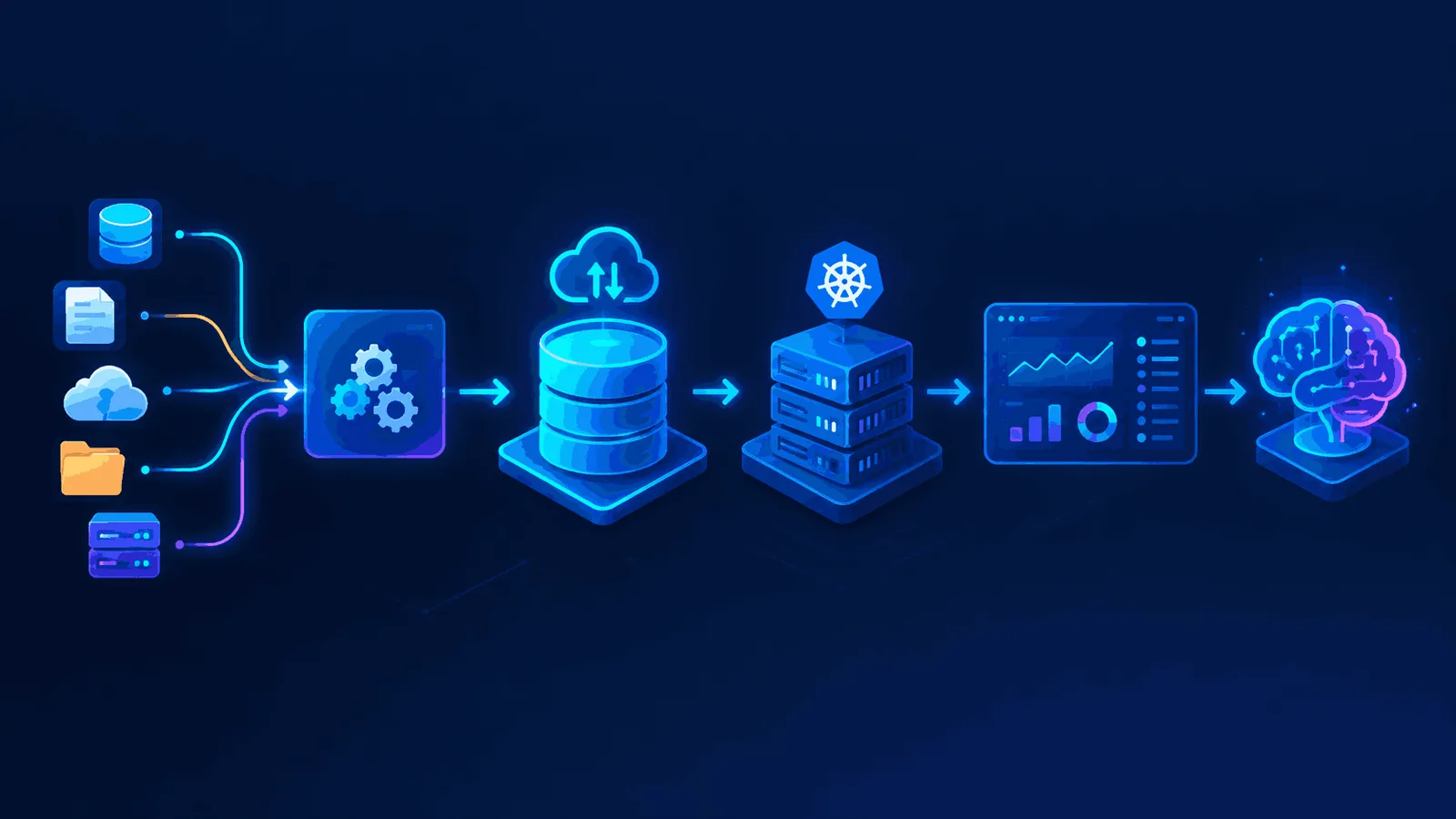
Data Ingestion

Develop controlled collection through APIs, database interfaces, file ingestion, scheduled imports, brokers, webhooks, event streams, edge gateways, industrial-data interfaces, document uploads, and repository sync.

Data Transformation

Validate fields, standardise names and units, convert formats, align timestamps, remove or identify duplicates, map identifiers, enrich records, calculate approved metrics, and preserve source lineage.

Data Storage

Select suitable relational, time-series, object, document, search, vector, cache, local edge, cloud, or hybrid storage based on query patterns, volume, retention, latency, recovery, and security.

Knowledge Refresh

Detect source changes, reprocess changed content, replace outdated index entries, preserve audit information, run regression questions, report status, and notify operators of failures.

DevOps and Operations

Define environments, version control, CI checks, release approval, deployment records, health checks, rollback preparation, monitoring, backup, recovery, and operational ownership.

Data Engineering for Generative AI

Knowledge pipelines keep approved documents searchable, current, permission-aware, and ready for evaluation before AI changes reach users.

Document ingestion

Knowledge indexing

Knowledge refresh

AI evaluation data

Version control

Containerisation

Infrastructure as code

Security governance

Delivery Process

A staged foundation helps data, deployment, monitoring, security, and recovery mature together.

Discover

Identify data sources, applications, users, deployment environments, operational problems, and ownership.

Assess

Review access, data quality, update rates, volume, interfaces, infrastructure, security constraints, and operational readiness.

Architect

Define ingestion, transformation, storage, retrieval, application, deployment, monitoring, and recovery components.

Build

Implement a bounded pipeline and application environment using selected representative data.

Validate

Test correctness, duplicates, delay, outage recovery, security boundaries, deployment rollback, and monitoring behaviour.

Operate

Deploy with logging, alerts, support responsibilities, runbooks, backup, and incident-handling procedures.

Improve

Use measured failures, performance, user feedback, and cost information to plan controlled improvements.

Deliverables Can Include

Data Engineering and DevOps scope should address security, recovery, monitoring, change approvals, retention, and operational support.

01Source-system assessment
02Data ingestion architecture
03Transformation and validation rules
04Storage and indexing plan
05Data-quality monitoring design
06Metadata and lineage model
07AI knowledge-pipeline design
08Evaluation dataset plan
09CI/CD workflow
10Deployment and rollback process
11Observability dashboard requirements
12Backup and recovery plan
13Security and governance checklist

Frequently Asked Questions

Q

Why is data engineering necessary for a generative AI application?

A

The AI must receive current, correctly processed, authorised, and searchable information. Without maintained pipelines, answers can depend on incomplete or outdated sources.

Q

Do we need a separate data platform before an AI pilot?

A

Not always. A pilot can begin with a limited approved document collection or data source, then define long-term architecture after value is demonstrated.

Q

Can you connect machine data to an AI application?

A

Potentially, yes. The first step is to define the operational question, identify available machine data, and determine whether it is suitable for AI-assisted interpretation.

Q

What is the difference between DevOps and MLOps?

A

DevOps manages software development, testing, release, and operation. MLOps adds model data, model versions, evaluations, drift, and AI-specific monitoring.

Q

Can the system be deployed on premises?

A

Possibly. Feasibility depends on the model, infrastructure, performance requirements, document sensitivity, integration needs, and support capability.

Q

Does CI/CD mean every change goes straight to production?

A

No. CI/CD can automate checks and prepare releases while still retaining an authorised production-approval gate.

Build a Dependable Foundation for Your AI Application

Share your data sources, document repositories, applications, deployment environment, expected users, security requirements, and current operational challenges.

Discuss Your Data and DevOps Architecture
Find us

MayilVeera Tech Solutions and Consultancy

Visit or contact our Chennai team for industrial automation, embedded systems, product engineering, IIoT, and connected-device discussions.

Open in Maps