
Industrial Protocol Testing for Reliable Interoperability

Verify more than a successful connection. Test message correctness, supported functions, timing, error handling, recovery, security configuration, and interoperability with intended devices and applications.

MessageCorrectness
PeerTesting
RecoveryTiming
Industrial protocol and interoperability testing

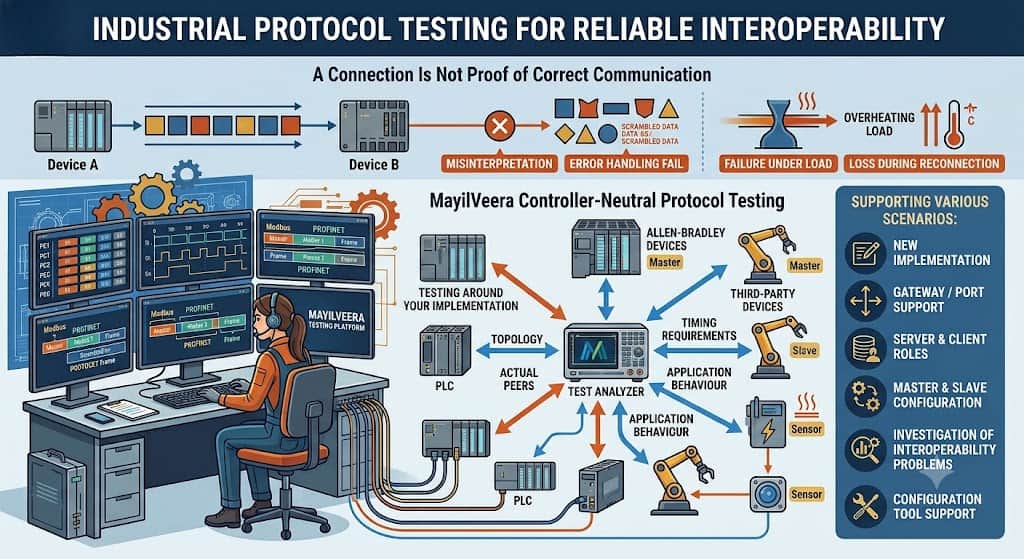
A Connection Is Not Proof of Correct Communication

Two products may establish communication but still interpret data differently, handle errors incorrectly, lose information during reconnection, or fail under load.

MayilVeera provides controller-neutral protocol testing around the customer's actual implementation, peer device, topology, timing requirements, and application behaviour.

Testing can support a new implementation, controller port, gateway, server, client, master, slave, configuration tool, or investigation of an interoperability problem.

Types of Protocol Testing

Protocol testing verifies supported functions, message correctness, invalid cases, timing, recovery, security configuration, and defined interoperability.

Functional Testing

Verify that supported protocol functions behave as documented using valid requests, expected sequences, supported data, normal timing, minimum and maximum values, and state-dependent behaviour.
Message and Frame Validation

Check headers, addressing, function or service identifiers, length, sequence, payload format, data type, byte order, checksums, error responses, and state-dependent behaviour.

Negative and Boundary Testing

Exercise unsupported functions, invalid addresses, invalid lengths, malformed messages, out-of-range values, missing fields, duplicate messages, expired sessions, invalid credentials, timeouts, disconnections, and transition values.

Performance and Endurance Testing

Measure request rate, response time, update rate, throughput, cycle time, jitter, subscriptions, connection count, node or register count, CPU, memory, queues, data loss, recovery time, resource leakage, latency growth, and long-duration stability.

Interoperability and Recovery Testing

Test against defined third-party products and verify behaviour after cable disconnection, network loss, peer restart, device restart, server restart, session expiry, timeout, invalid data, partial transmission, configuration change, IP change, and certificate changes.

Security-Configuration Testing

Where supported, test authentication, authorisation, certificate handling, encryption configuration, session management, security policy selection, rejected credentials, expired certificates, role access, and sensitive-data exposure.

Protocols and Interfaces

Supported protocols must be confirmed against engineering capability, tools, hardware, stacks, specifications, and peer equipment.

OPC UA

Modbus RTU

Modbus TCP

EtherCAT

MQTT

REST APIs

WebSocket communication

Custom protocols

Protocol-Specific Test Areas

Protocol scope is selected according to role, stack, peer products, test tools, timing requirements, and certification responsibilities.

OPC UA

Endpoint discovery, secure channels, sessions, namespaces, browsing, read/write, data types, status codes, timestamps, method calls, subscriptions, monitored items, events, reconnection, certificates, policies, roles, information model, multiple clients, load, and long-duration operation.

Modbus

Addressing, unit identifier, function codes, coils, discrete inputs, holding registers, input registers, writes, register ranges, exceptions, CRC, transaction identifiers, endianness, scaling, signed and unsigned values, floating point mapping, retries, poll rate, invalid addresses, and gateway behaviour.

EtherCAT

Slave discovery, topology, configuration data, state transitions, process data, service data, input and output mapping, working counter, watchdogs, distributed clocks, cycle timing, lost frames, cable interruption, restart behaviour, error states, multi-slave operation, and defined master interoperability.

Custom Protocols

Protocol specification, message definition, state model, field definitions, data types, error responses, timing rules, retry rules, versioning, compatibility expectations, reference encoder and decoder, simulation tools, test vectors, and automated regression tests.

Protocol Test Evidence

Results should identify exact tested products, versions, configurations, security modes, functions, outcomes, limitations, and remaining certification responsibilities.

01Protocol test plan
02Supported-function matrix
03Register or node test mapping
04Test configuration
05Device and software versions
06Message or frame captures
07Timing results
08Negative-test results
09Interoperability matrix
10Reconnection results
11Performance results
12Defect reports
13Retest evidence
14Known deviations
15Pre-compliance observations
16Remaining certification responsibilities

Frequently Asked Questions

Q

Is protocol testing the same as protocol certification?

A

No. Engineering testing and pre-compliance testing can identify problems, but official certification is provided only through the applicable authorised process.

Q

Can you test our server against several clients?

A

Yes, if the required client products and versions are available. Results apply only to the tested combinations.

Q

Can a simulator replace testing with the actual device?

A

A simulator is valuable for repeatability, negative cases, and early development. Final interoperability still requires representative real products where that is part of the requirement.

Q

Can you automate protocol tests?

A

Yes. Stable request-response, negative, regression, performance, and reconnection cases can often be automated.

Q

Can you diagnose intermittent communication failures?

A

We can capture software logs and physical or network communication evidence, correlate timing, reproduce conditions, and separate application, stack, configuration, wiring, and peer-device factors.

Need Confidence in Your Industrial Communication Interface?

Share the protocol, device role, stack, controller, peer product, topology, expected functions, timing requirements, and current failure symptoms.

Request a Protocol Test Assessment
Find us

MayilVeera Tech Solutions and Consultancy

Visit or contact our Chennai team for industrial automation, embedded systems, product engineering, IIoT, and connected-device discussions.

Open in Maps