
Configurable source and destination connectors
Move Industrial Data Between Systems with Controlled Mapping
Connect selected industrial data sources to destination applications through configurable acquisition, transformation, filtering, and routing.
Multi-ProtocolData Exchange
ControlledTag Mapping
Source-to-TargetData Flow
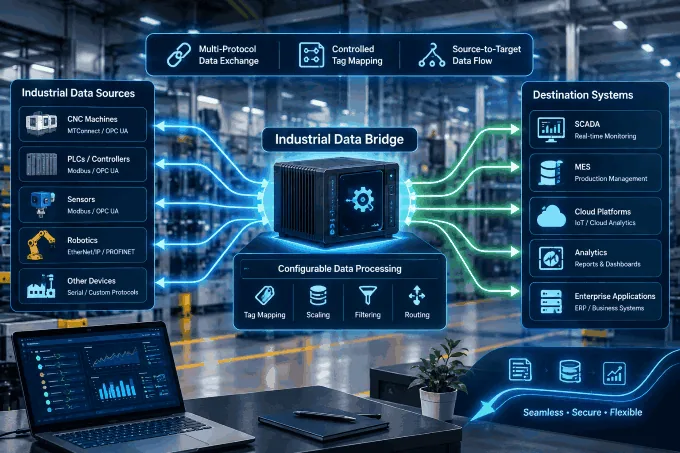
Industrial Data Bridge
The MayilVeera Industrial Data Bridge is a configurable integration component for transferring operational data between industrial systems. It separates source connectivity from destination connectivity and provides a central place to define tag mapping, naming, scaling, filtering, and routing rules.
It is suitable where plant data must be exchanged between systems without embedding every protocol and transformation rule directly into the end application.
Logical Architecture
A website-level view of how the product connects sources, processing layers, diagnostics, and destination systems.
Industrial Data Sources
ControllersOPC UAModbusFilesDatabasesAPIs
01
Source Connectors
02
Normalisation and Tag Mapping
NamingTypesUnitsScalingQualityTime
03
Rules and Routing Engine
FilterDeadbandTriggerDestination Mapping
04
Destination Connectors
SCADAHistorianMESDatabaseAnalyticsCloud Platform
Key Capabilities
Tag selection and name mapping
Data-type and engineering-unit conversion
Scaling, filtering, and deadband rules
Timestamp and quality handling
Periodic, event-driven, or change-based transfer—subject to connector support
Connection-health monitoring
Diagnostic logs and transfer counters
Configuration import and export
Optional buffering only when implemented and validated
How It Works
The document flow is presented as an implementation-style process so visitors can understand the operating path quickly.
- 01
Source and destination connections are configured.
- 02
Required source points are selected.
- 03
Data types, names, units, scaling, and destination tags are mapped.
- 04
Transfer triggers and filtering rules are defined.
- 05
The bridge reads or receives source values and routes them to the destination.
- 06
Communication status, rejected data, mapping errors, and transfer counts are recorded.
Applications
Where It Fits
OT-to-IT data integration
Moving controller information to databases
Connecting production data to historians
Feeding dashboards and analytics systems
Protocol and system migration
Plant-to-cloud data routing
Consolidating multiple data sources
Test-data and laboratory integration
Connecting legacy systems with modern applications
Selective data exchange between network zones
Benefits
Practical Benefits
Reduces point-to-point custom integrations
Centralises mapping and transformation rules
Allows source and destination systems to evolve independently
Improves visibility into transfer failures and connection health
Supports incremental modernisation of existing systems
Integration and Deployment
Integration requires confirmation of source and destination protocols, tag volume, update behaviour, quality and timestamp requirements, write-back requirements, network boundaries, authentication, and failure-recovery expectations.
Reliability and Security
Connector-specific authentication
Encrypted transport where supported
Retry and reconnection policy
Data-quality propagation
Transfer and error counters
Diagnostic logging
Configuration backup
Optional local persistence only if included in the verified product version
Need Help Selecting the Right Product?
Equipment and controller make or model
Required interfaces, protocols, channels, or tag count
Operating environment and target platform
Update rate, cycle time, delivery schedule, and custom engineering needs
Do not publish price, availability, certification, warranty, protocol, electrical rating, capacity, performance, or compatibility statements until they are linked to the exact shipping SKU or software version.
Frequently Asked Questions
Can it connect any two industrial systems?
Only when compatible source and destination connectors are available or included through an agreed custom-integration scope.
Does it guarantee that no data will be lost during an outage?
That depends on whether the selected version includes persistent buffering and on its configured capacity and recovery policy.
Can values be written back to the source?
Bidirectional transfer should be enabled only for connectors and mapped points that support controlled write operations.
Simplify Industrial Data Integration
Share the source protocol, destination system, data volume, update frequency, network topology, retention needs, and write-back requirements for a connector and architecture assessment.
Start Your Product Discussion