
Remote ON/OFF Control Solutions

Control selected appliances, pumps, motors, lights, and industrial equipment through properly engineered local and remote interfaces with real status, safety interlocks, and event traceability.

RemoteAnd Local Control
RealStatus Feedback
EventLogging
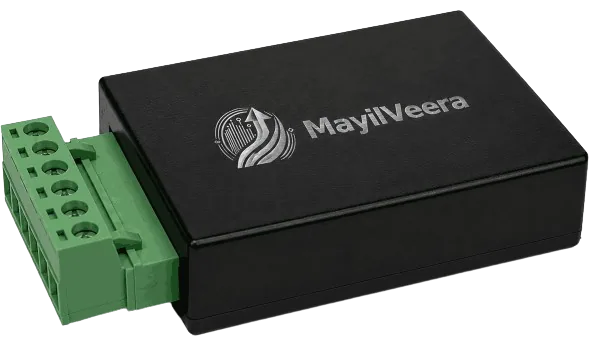
iSwitch remote ON/OFF control product

Remote Control Is More Than Sending an ON or OFF Command

A reliable remote-control solution must confirm the actual equipment state, preserve local operation, handle network or controller failures, restrict unauthorized users, and respect electrical and process-safety interlocks.

MayilVeera develops remote ON/OFF control solutions based on load, control panel, operating environment, electrical rating, communication, user roles, and required failure behavior.

The MayilVeera iSwitch can support suitable home, agricultural, pump, lighting, and small-equipment applications. Industrial or higher-power equipment may require rated contactors, overload protection, PLC interfaces, feedback signals, enclosures, and site-specific safety design.

Remote-Control Capabilities

Remote switching is engineered around authorization, status feedback, schedules, local modes, interlocks, and auditability.

Authorized Remote Switching

Provide permitted users with a controlled mobile, web, local panel, scheduled, API, or supervisory interface.
Actual Status Feedback

Display equipment state from feedback such as contactor auxiliary contact, relay feedback, current, pressure, flow, PLC status, fault, or trip signals.

Scheduling and Timed Operation

Support daily schedules, timers, operating windows, maximum-run timers, and automatic stop logic where suitable.

Local and Remote Modes

Support local, remote, automatic, off, or maintenance modes according to the application and electrical topology.

Interlocks and Preconditions

Check emergency stop, overload, level, pressure, guards, permissives, alarms, and lockout conditions before accepting commands.

User Access and Audit Trail

Record users, requests, command outcomes, status changes, trips, communication loss, and maintenance events where required.

Core Remote-Control Capabilities

The correct implementation depends on electrical rating, feedback source, communication reliability, and site safety requirements.

Remote access

Local control

Status feedback

Schedules

Interlocks

User permissions

Fault alerts

Event logging

How Remote Control Is Engineered

The design defines command flow, feedback, failure behavior, and safe operating boundaries.

Load Review

Review equipment rating, panel design, contactor, starter, protection, and available feedback.

Safety Review

Define interlocks, manual modes, emergency behavior, lockout needs, and unacceptable actions.

Control Design

Select iSwitch, relay, PLC, gateway, app, or dashboard architecture.

Feedback Mapping

Map real equipment state, fault, trip, communication, and command status.

User Rules

Configure users, roles, schedules, timers, alerts, and audit events.

Testing

Test command, feedback, local operation, offline behavior, and failure scenarios.

Control Boundaries

Remote control must not bypass the equipment's existing safety circuit or formal operating procedure.

01Load and panel assessment
02Control architecture
03Feedback signal plan
04Local/remote mode definition
05Interlock checklist
06User permission model
07Schedule rules
08Failure behavior definition
09Event log design
10Testing and handover notes

Frequently Asked Questions

Q

Can iSwitch control industrial motors directly?

A

Higher-power or industrial equipment may require contactors, starters, overloads, relays, PLC interfaces, enclosures, and site-specific safety design.

Q

Can the app show real equipment status?

A

Yes, when a suitable feedback signal is wired and configured. Last command status alone is not the same as actual equipment status.

Q

Can schedules run without the Internet?

A

This depends on the selected controller and clock behavior. Offline and failure behavior should be defined during engineering.

Q

Can remote control bypass safety interlocks?

A

No. Remote control must respect existing safety circuits and project-specific permissives.

Design Remote Control with Real Operating Boundaries

Share the equipment type, electrical rating, existing panel details, feedback signals, users, schedules, and required failure behavior.

Plan Remote ON/OFF Control
Find us

MayilVeera Tech Solutions and Consultancy

Visit or contact our Chennai team for industrial automation, embedded systems, product engineering, IIoT, and connected-device discussions.

Open in Maps