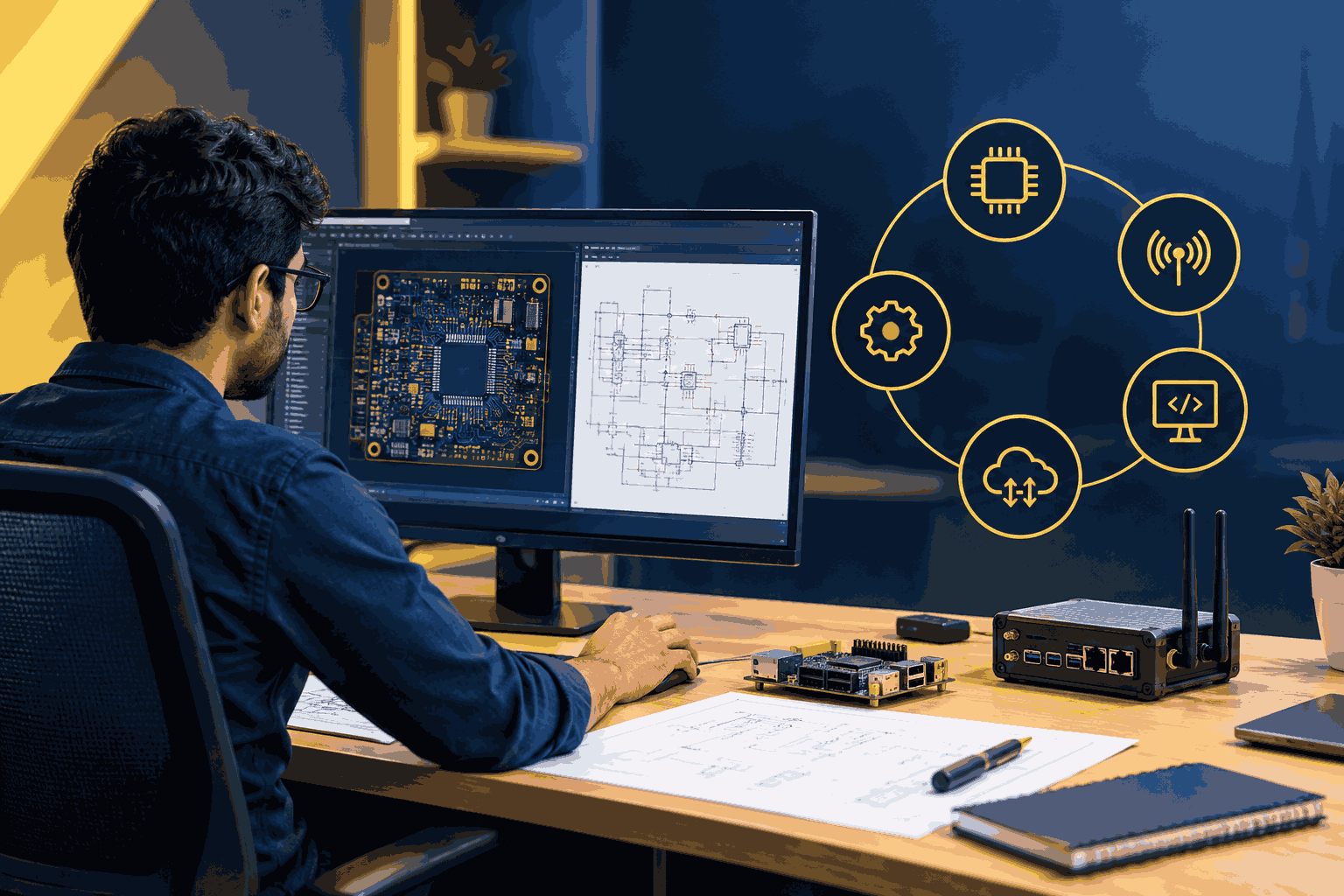
The engagement begins by understanding the problem the product must solve, not by selecting a processor or platform prematurely.
Product Requirement Definition
We convert the initial idea into engineering requirements covering users, applications, functions, inputs, outputs, communication, response time, power, mechanical constraints, service needs, security, device management, target quantity, cost, testing, and compliance expectations.
Feasibility Study
We assess technology options, component availability, interface feasibility, processing and memory needs, power and thermal considerations, communication coverage, software dependencies, risks, prototype needs, and indicative development stages.
System Architecture
We define how the processor, sensors, actuators, analogue and digital interfaces, power system, wired or wireless communication, firmware, operating system, storage, edge functions, cloud interfaces, diagnostics, and update paths work together.
Proof-of-Concept Development
A focused proof of concept can validate high-risk elements such as sensors, actuators, communication, controller selection, data rates, industrial protocols, edge-to-cloud paths, power needs, and user workflows before full design investment.
Prototype Engineering
After feasibility approval, the concept can become an engineering prototype with selected electronics, firmware, interfaces, and enclosure constraints, then be evaluated for behaviour, reliability, recovery, updates, operating conditions, boundary cases, and physical integration.
Product Re-Engineering and Enhancement
We support existing products that need component replacement, controller migration, new communication interfaces, firmware redevelopment, embedded Linux migration, performance improvement, security enhancement, feature additions, documentation recovery, or obsolescence-driven redesign.