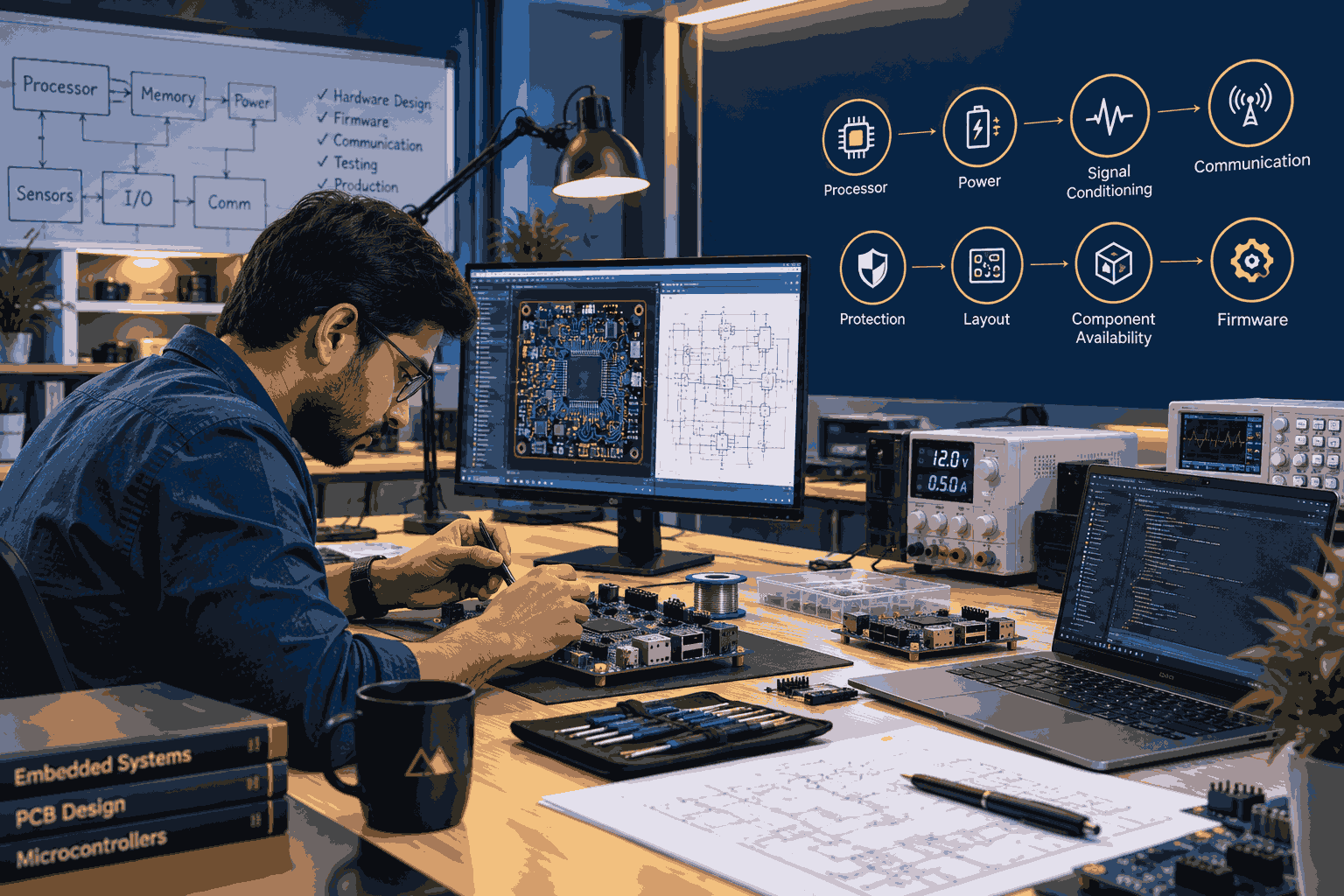
Hardware decisions are reviewed against processing needs, development complexity, component lifecycle, cost, firmware support, manufacturing needs, and validation scope.
Hardware Architecture
We define MCU, MPU, SoC, or compute-module choices, memory, storage, analogue and digital I/O, output drivers, sensor interfaces, communication, power sequencing, protection, debug access, user-interface parts, and service interfaces.
Schematic Design
We develop schematics for microcontroller and processor circuits, signal conditioning, digital I/O, relay and actuator interfaces, power supplies, isolation, industrial serial communication, Ethernet, wireless modules, sensors, debug connections, status indication, and user controls.
Component Selection and BOM Development
Components are selected around electrical requirements, operating conditions, availability, lifecycle, package and assembly constraints, firmware support, power use, cost, tolerances, and replacement options.
PCB Design Support
PCB development can include board outline, placement planning, layer-stack consideration, power and ground distribution, signal routing, isolation, clearances, connector access, programming and test points, mechanical constraints, assembly needs, and manufacturing files.
Prototype Coordination and Board Bring-Up
We support prototype manufacturing-data preparation, fabrication and assembly coordination, inspection, programming preparation, board bring-up, subsystem verification, interface tests, communication tests, and prototype defect investigation.
Existing-Hardware Improvement
We assess component obsolescence, availability problems, cost, power, thermal issues, signal quality, communication failures, missing protection, manufacturing difficulties, test-access limitations, and required feature additions.