Embedded Hardware Testing Based on Measurable Evidence

Verify that your embedded hardware operates as intended across its defined functions, interfaces, and electrical boundaries. MayilVeera provides structured board verification, hardware-firmware integration testing, and defect investigation.

BoardVerification
IntegrationTesting
DefectInvestigation
Embedded hardware communication and testing

Find Problems Before They Reach the Field

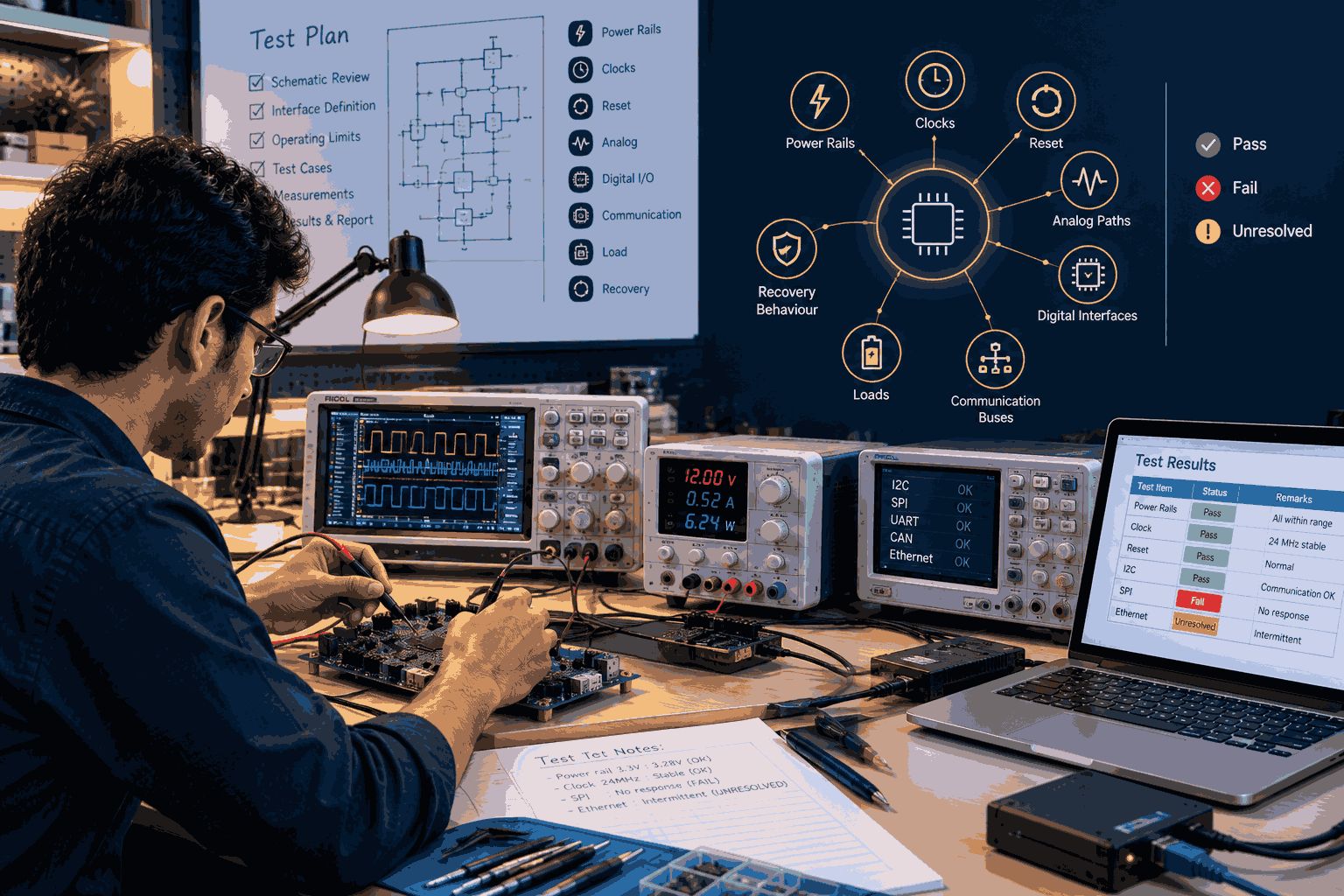
A board powering on or accepting firmware does not prove that every circuit and interface is working correctly. Power rails, clocks, reset signals, analogue paths, digital interfaces, communication buses, loads, and recovery behaviour must be verified independently.

MayilVeera creates a test plan from the product's requirements, schematic, interface definitions, and expected operating limits. Results are recorded as measurements and observations so pass, fail, and unresolved items can be distinguished clearly.

Our Hardware Testing Services

Testing can support a new prototype, a design revision, an existing production issue, or a specific hardware-firmware integration problem.

Design and Test Readiness Review

Before lab work begins, we review requirements, architecture, schematics, PCB files, BOM, datasheets, interface definitions, firmware version, known issues, electrical limits, test procedures, fixtures, and instruments. Missing information and test limitations are recorded before conclusions are made.

Visual and Assembly Inspection

Initial checks can cover PCB and assembly condition, component orientation, missing or incorrect components, visible soldering defects, connector and cable condition, mechanical interference, assembly variation, damage, and contamination.

Power-System Verification

Power testing can cover input current, rail voltages, rail sequencing, reset behaviour, inrush observations, regulator output, load response, power consumption, brownout and restart behaviour, and protection behaviour within an agreed safe test range.

Digital Interface Verification

We verify supported digital interfaces with appropriate instruments and test firmware, including GPIO, UART, SPI, I2C, CAN, Ethernet, USB, PWM, timers, counters, interrupts, external memory, and programming or debug interfaces.

Analogue and Sensor Interface Testing

Tests can include input range, offset and gain observations, ADC readings, DAC or analogue-output checks, sensor excitation, signal conditioning, noise observations, channel consistency, calibration-data handling, and boundary-input cases.

Communication Testing

Communication verification can include physical-layer observation, baud rate or clock checks, frame and packet inspection, addressing, configuration, error and timeout behaviour, reconnection, data integrity, interoperability, and extended-run tests.

Hardware-Firmware Integration Testing

Integration testing verifies pin configuration, peripheral selection, clocks, interrupts, buffers, memory, DMA, timing, reset, startup, power states, driver errors, watchdog recovery, and bootloader/application interaction.

Thermal and Extended-Operation Observation

Where equipment and scope permit, we monitor component temperature, board temperature, power consumption, communication stability, memory or resource behaviour, restart events, output consistency, and long-duration operation under representative load.

✓

Functional and Boundary Testing

Verify product behavior across normal, boundary, failure, recovery, and repeated operating conditions.

⚙Expected product functions
↕Minimum and maximum valid inputs
⚠Invalid or missing inputs
⌁Sensor disconnection
⇄Communication loss
⏻Power interruption
↻Restart and recovery
▣Storage-full or configuration-error cases
⟳Repeated operation
⇆Multiple-interface interaction
🛡Defined fail-safe states
⚙

Production Test Planning

Define production-ready test procedures, limits, traceability, inspection, and defect-isolation requirements.

▣Board programming procedure
⌖Test-point access
✓Functional test sequence
↔Test limits
✓Pass/fail criteria
▤Device identity and traceability
◈Firmware-version verification
▤Production log format
▦Fixture concept
⚠Defect-isolation guidance
☑Final inspection checklist

Testing, Pre-Compliance, and Certification Are Different

MayilVeera should not describe a product as compliant or certified solely because internal engineering tests passed. Safety-related functions require an appropriate safety lifecycle. Formal calibration requires suitable reference equipment, methods, traceability, and where claimed, accredited calibration facilities.

Engineering Verification

Checks whether the product satisfies the agreed functional and design requirements.

Pre-Compliance Testing

Evaluates selected characteristics before formal certification and helps identify issues that may need correction.

Formal Certification

Must be performed according to the applicable standard and certification process, normally through an authorised or accredited external facility.

Test Evidence and Deliverables

A hypothesis is not reported as a confirmed root cause until supporting evidence is obtained. Production fixtures and automated test equipment can be scoped separately.

01Test strategy
02Test plan
03Test-case list
04Test setup description
05Equipment list
06Firmware and hardware revision record
07Measurement results
08Oscilloscope or logic-analyser captures
09Communication traces
10Pass/fail summary
11Defect report
12Reproduction procedure
13Root-cause hypothesis
14Corrective-action recommendation
15Retest evidence
16Known limitations and untested boundaries

Frequently Asked Questions

Q

Can you test a board without its firmware?

A

Some electrical and subsystem tests are possible, but complete functional verification normally requires controlled test firmware or the intended application firmware.

Q

Can you diagnose an intermittent failure?

A

We can define a reproduction method, capture relevant signals and logs, compare good and failed conditions, and progressively isolate the fault. Intermittent issues may require extended testing or additional instrumentation.

Q

Does passing hardware testing mean the product is certified?

A

No. Engineering testing, pre-compliance evaluation, and formal certification are separate activities.

Q

Can you test an existing third-party design?

A

Yes, subject to access to the hardware, documentation, firmware, test interfaces, and any required permissions.

Q

Will one prototype be enough for complete validation?

A

Not necessarily. The number of units depends on the tests, expected variation, failure modes, destructive-test requirements, and confidence needed.

Q

Can you develop a production-test fixture?

A

A production-test fixture and associated software can be scoped after the board's test points, programming method, production volume, test time, and acceptance criteria are understood.

Need Evidence Before Your Next Design Revision?

Share the product requirements, schematic, board revision, firmware version, known symptoms, and tests already completed. We will help define the next verification steps.

Request a Testing Discussion
Find us

MayilVeera Tech Solutions and Consultancy

Visit or contact our Chennai team for industrial automation, embedded systems, product engineering, IIoT, and connected-device discussions.

Open in Maps