
Digital input and output acquisition
Distributed EtherCAT I/O for Machine and Equipment Integration
Acquire and control digital and analog field signals through an EtherCAT-connected I/O module designed for distributed automation architectures.
DistributedI/O Architecture
Digital + AnalogSignal Handling
EtherCATMachine Integration
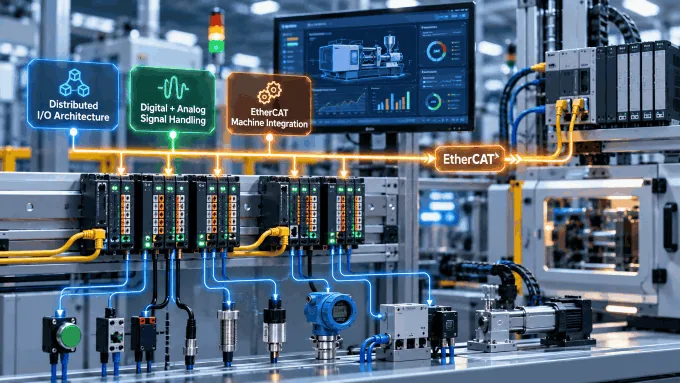
Multi-Channel Digital/Analog I/O Module — EtherCAT
The MayilVeera EtherCAT I/O Module connects field-level digital and analog signals to an EtherCAT automation network. It can be positioned close to sensors, switches, relays, actuators, and process signals to reduce field wiring and bring distributed I/O into the machine-control architecture.
The exact I/O configuration, electrical ratings, protection, connector arrangement, and EtherCAT implementation must be published per part number and hardware revision.
Logical Architecture
A website-level view of how the product connects sources, processing layers, diagnostics, and destination systems.
EtherCAT MainDevice / Machine Controller
01
EtherCAT Network
02
EtherCAT Communication Layer
State MachineProcess DataSynchronisation
03
Local Control and Diagnostics
04
Signal Conditioning and Isolation
Digital Input/Output
SensorsSwitchesRelays
Analog Input/Output
TransmittersActuators
Key Capabilities
Analog input and output support, according to model
EtherCAT process-data exchange
Configurable channel mapping
Channel and communication diagnostics
Distributed mounting close to equipment
Defined power-up and communication-loss behaviour
Engineering and commissioning information through device description files
How It Works
The document flow is presented as an implementation-style process so visitors can understand the operating path quickly.
- 01
The controller exchanges cyclic process data with the I/O module over EtherCAT. The module converts field-side electrical signals into process data and converts controller commands into field outputs. Diagnostic information can report channel, power, or communication conditions according to the hardware implementation.
Applications
Where It Fits
Machine-building I/O
Distributed sensor and actuator connection
Packaging equipment
Assembly machinery
Test stands
Motion-control auxiliary I/O
Conveyor and material-handling systems
Process skids
Retrofit I/O expansion
Laboratory automation
Benefits
Practical Benefits
Places I/O closer to field devices
Reduces long point-to-point wiring
Integrates mixed signals into an EtherCAT architecture
Supports modular machine design
Provides channel and network diagnostics from a central control system
Integration and Deployment
Integration requires the exact module part number, controller or MainDevice, ESI file, process-data layout, cycle requirements, power design, grounding, shielding, cable arrangement, safe-state requirements, and field-signal details.
Reliability and Safety
Define output state on network loss
Define output state on watchdog expiry
Define behaviour during startup and undervoltage
Verify electrical isolation and channel protection
Use external safety circuits for safety functions
Do not use standard I/O as safety I/O unless the exact product is designed and certified for that purpose
Need Help Selecting the Right Product?
Equipment and controller make or model
Required interfaces, protocols, channels, or tag count
Operating environment and target platform
Update rate, cycle time, delivery schedule, and custom engineering needs
Do not publish price, availability, certification, warranty, protocol, electrical rating, capacity, performance, or compatibility statements until they are linked to the exact shipping SKU or software version.
Frequently Asked Questions
Can it be used with any EtherCAT controller?
Compatibility depends on the controller, supported EtherCAT functions, ESI file, process-data mapping, and tested configuration.
Is it safety-rated I/O?
Not unless the exact model carries the required safety design and certification.
What happens to outputs if communication is lost?
The watchdog and safe-state behaviour must be defined and published for the exact hardware and firmware revision.
Select the Right EtherCAT I/O Configuration
Send the required channel types, signal ranges, output loads, controller model, cycle requirements, isolation needs, and operating environment for configuration review.
Start Your Product Discussion