
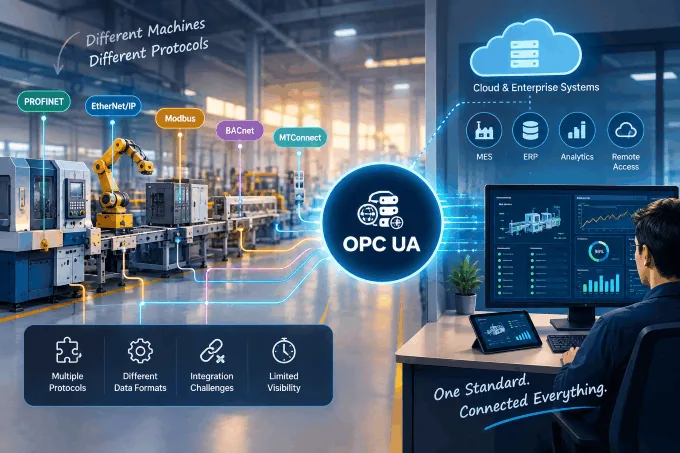
Introduction to OPC UA in Modern Manufacturing
Modern manufacturing facilities depend on seamless communication between machines, sensors, controllers, and enterprise software. However, many factories operate equipment from different manufacturers, each using its own communication protocols and data formats. This creates challenges when integrating machines into a centralized monitoring or automation system. OPC UA (Open Platform Communications Unified Architecture) addresses these challenges by providing a standardized, platform-independent communication framework. It enables industrial devices and software applications to exchange information reliably, helping manufacturers build connected, intelligent, and efficient production environments.
Eliminating Communication Barriers Between Machines
One of the biggest challenges on the factory floor is connecting industrial equipment from different manufacturers. PLCs, SCADA systems, industrial robots, and monitoring devices may use different proprietary communication protocols, making integration complex and expensive. OPC UA simplifies this process by establishing a common communication standard that supports interoperability across industrial systems. Instead of developing separate communication interfaces for every device, manufacturers can use OPC UA-compatible servers and clients to exchange standardized information. This reduces integration complexity, improves data accessibility, and creates a flexible foundation for expanding industrial automation infrastructure.
Enabling Real-Time Machine Monitoring and Data Collection
Access to accurate machine data is essential for improving production efficiency and reducing unexpected downtime. OPC UA enables industrial applications to access operational information such as machine status, temperature, pressure, production counts, and equipment alarms. Through its subscription and monitoring capabilities, OPC UA allows applications to receive updates when monitored values change. This information can be integrated into manufacturing dashboards, SCADA platforms, and Industrial Internet of Things (IIoT) solutions. By transforming isolated machine information into accessible operational insights, OPC UA helps manufacturers identify performance issues, monitor equipment conditions, and make faster, data-driven decisions.
Improving Industrial Security and System Reliability
As industrial networks become increasingly connected, protecting communication between machines and software systems becomes more important. OPC UA includes built-in security mechanisms such as application authentication, user authorization, message signing, and encryption. These features help protect industrial information against unauthorized access and data manipulation when properly configured. OPC UA also supports structured information models, allowing applications to understand not only machine values but also their relationships and meanings. Combined with appropriate network security practices, these capabilities help manufacturers establish more secure, maintainable, and reliable communication architectures across their industrial environments.
Building the Foundation for Smart Factories and Industry 4.0
OPC UA plays an important role in the transition toward smart manufacturing and Industry 4.0 by connecting operational technology with modern digital applications. Its standardized communication architecture enables manufacturers to integrate shop-floor equipment with MES, ERP, cloud platforms, and industrial analytics solutions through suitable gateways and software interfaces. This connectivity supports applications such as predictive maintenance, energy monitoring, production optimization, and centralized equipment management. Rather than replacing existing machinery, manufacturers can often introduce OPC UA through compatible controllers, gateways, or edge computing systems. By making industrial data more accessible, structured, and secure, OPC UA helps factories move toward scalable, data-driven, and future-ready manufacturing operations.